


The Holy Cross: from Genesis to the Gospels
The Feast of the Exaltation of the Holy Cross is observed by the Church on 14 September. This annual celebration marks the discovery of the remains of Christ’s cross by St Helena, in the fourth century AD. Parts of this relic, known as the ‘True Cross’, are found in churches across the world. Within the United Kingdom, a fragment is on display within the Bar Convent, in York.
This feast is an opportunity for the faithful to reflect on the crucifixion of Christ, and on the mystery of the cross as revealed in Scripture. Through works of church art, let’s look at these topics now.
The Tree of Life: sacred wood in the Bible and art

Faithful cross, above all other, One and only, noble tree! No forest produces such a wonder, Leaf, flower, and fruit you bear. Sweet the timber, sweet the nails, sweet the burden that you bear! – St Venantius
Preaching on the subject of the cross, Pope Benedict XVI explained: “Many might be tempted to ask why we Christians celebrate an instrument of torture, a sign of suffering, defeat and failure. It is true that the Cross expresses all these things. And yet, because of him who was lifted up on the Cross for our salvation, it also represents the definitive triumph of God’s love over all the evil in the world.”
He went on: “There is an ancient tradition that the wood of the Cross was taken from a tree planted by Adam’s son Seth over the place where Adam was buried. On that very spot, known as Golgotha, the place of the skull, Seth planted a seed from the tree of the knowledge of good and evil, the tree in the midst of the Garden of Eden. Through God’s providence, the work of the Evil One would be undone by turning his own weapons against him.”
The pope continued: “The wood of the Cross became the vehicle for our redemption, just as the tree from which it was fashioned had occasioned the Fall of our first parents. Suffering and death, which had been a consequence of sin, were to become the very means by which sin was vanquished. The innocent Lamb was slain on the altar of the Cross, and yet from the immolation of the victim new life burst forth: the power of evil was destroyed by the power of self-sacrificing love.”
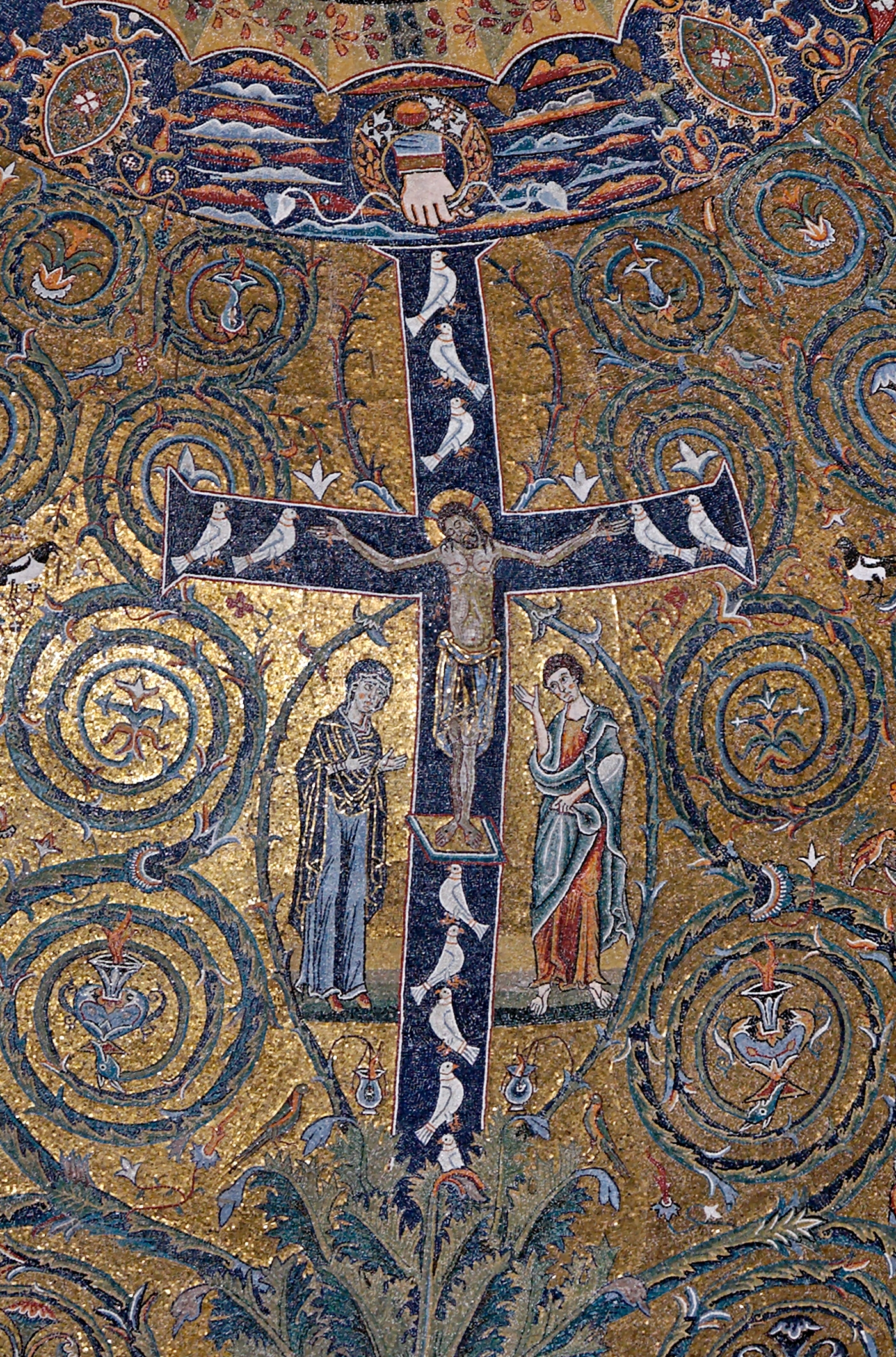
As a result of this comparison, in Christian preaching and art the cross came to be referred to as the Lignum Vitae – the tree of life. In the church of San Clemente in Rome, for example, there is a beautiful 12th century mosaic of the Cross, represented as a living tree with green leaves.
In the Middle Ages, this symbolism was sometimes merged with the imagery of the Jesse Tree, which visually presents the royal ancestry of Christ as a family tree. You can see a more recent example of that in this image from St Mary’s, in Gosport.
Building on this connection between the two trees – in Eden and on Calvary – Christian interpreters have long noted that throughout the Bible, there are many references to the sacred role of trees, and of wood.
The Book of Genesis says that Noah’s Ark, the means by which God saved the human race, was made from wood (Genesis 6:13-16; cf Wisdom 10:4). Later in Genesis, we read of how Isaac carried a bundle of wood up to the mountain on which he was destined to die (Genesis 22:6). This was later understood by Christian interpreters as a symbol of Christ carrying his cross.
During the Exodus, timber continued to play a sacred role. The miraculous staff of Moses was made of wood (Exodus 4:1-5). Moses purified the waters of the wilderness with a branch that God had shown him (Exodus 15:22-25). The book of Exodus later says that the Ark of the Covenant, at God’s specific command, was to made from wood (Exodus 25:10-22). Moses was also told to raise an image of a bronze serpent on a wooden pole, as a symbol of salvation (Numbers 21:4-9).
Following King David’s spiritual design, the Temple of Solomon was panelled with cedar wood, and adorned with carvings of palm trees on its walls and doors (1 Kings 6:14-38). The Menorah, a seven-branched golden lampstand, was also placed in the sanctuary, symbolising an almond tree (Exodus 25:31-40; 1 Kings 7:48-49).
In the Prophets, we find references to the coming of the ‘Branch’ – a righteous king who would rescue Israel. In the Book of Isaiah, we read how this Branch would descend from Jesse, the father of King David (Isaiah 11:1-2,10). In the books of Jeremiah and Zechariah, the Branch is described as the anointed king, the servant of God, who would rule with justice (Jeremiah 23:5; 33:15; Zechariah 3:8).
In the gospels, there is mystery in the fact that St Joseph, and Christ himself, were woodworkers (Matthew 13:55; Mark 6:3). In artistic scenes of Christ’s childhood, he is often pictured working in his father’s workshop, fashioning a cross-shaped item (as above). He also grew up in Nazareth (which means ‘Branchtown’), and was therefore known as ‘Jesus of Nazareth’ (Luke 24:19; John 18:5).
We also read of how Christ compared himself to a fruitful tree, saying to his disciples: “I am the vine, you are the branches.” (John 15:5). In a similar way, in the Parable of the Mustard Seed, he compared the Kingdom of God to a large mustard tree (Matthew 13:31-32).
In the Book of Revelation, the last book of the Bible, we find reference to “the tree of life” (Revelation 2:7; 22:2,14,19). This tree – which was planted in the original paradise of Eden – will be found in the restored paradise at the end of time.
Here are some stories from the Bible which underline the role of the tree of life, and of timber, in God’s plan for salvation:
2. Noah’s Ark
3. Isaac carries the wood up the mountain
4. Moses raises the bronze serpent
The Mystery of the Cross in Scripture

God fulfilled what he had foretold through all the Prophets, revealing that his Christ would suffer. – Acts 3:18
The story of Christ’s passion and death does not begin in the New Testament. As St Peter said in the quotation above, the mystery of the cross is first revealed in the Old Testament.
Throughout the Prophets, we find references to the forthcoming suffering and death of the Messiah. Isaiah spoke of a Suffering Servant who would die for others, Zechariah wrote of the mourning over the Messiah, who would be struck down, while King David sang of the pierced hands and feet of the afflicted one (Isaiah 52:13-53:12; Zechariah 12:10-14; 13:7; Psalm 22:1-18).
As we see in this stained glass scene within the Cathedral of St John the Baptist, in Norwich, the arrival of the Messiah and his brutal death was foretold by various prophets. In church art, the prophets are often pictured like this, holding banners with quotations from their writings that refer to the life and death of Christ.
In the New Testament, Jesus made reference to these ancient prophecies, saying that his suffering and death had been written about in the Old Testament (Mark 9:12; 14:27; cf Luke 22:37; 24:26-27, 44-46). St John the Baptist, similarly, referred to Christ as “the Lamb who takes away the sins of the world.” (John 1:29,35) In doing so, he was making reference to Isaiah’s prophecy of the Suffering Servant, and to the slaughter of the Passover Lamb (Isaiah 53:7).
In the gospels, the story of the suffering and death of Christ takes the spotlight. Christ spoke to his disciples about his tragic end many times, predicting that he would be condemned to death, mocked, scourged and crucified (Matthew 16:21; 17:22-23; 20:17-19; Luke 13:33; John 10:11,17-18).
Around 30-40% of each gospel is devoted to telling the story of the very last week of Christ’s life. Within them, we find the story of how Christ was arrested, condemned to death, mocked and flogged, forced to carry the cross and then crucified on it at Golgotha.
Within Catholic churches, these scenes are most popularly pictured in the Stations of the Cross or in images illustrating the Sorrowful Mysteries of the Rosary, as well as in the other ways described below.
Here are some examples of the mystery of the cross, as found in both the Old and New Testament, in church art:
1. The Passover
2. The Crucifixion in the Psalms
4. The Piercing of the Messiah
7. Simon of Cyrene helps Christ
8. Christ is stripped of his clothes
The Holy Cross in church art

Then Jesus came out, wearing the crown of thorns and the purple robe. Pilate said to them, “Behold, the man!” – John 19:3
In church art, the cross is often pictured in five different ways – in the stained glass of an East Window, as a Crucifix or Rood, in the Stations of the Cross, within the very architecture of the church itself, and on various liturgical objects.
1. The East Window
It’s very common to find a stained glass scene of the Crucifixion of Christ in the East Window of a church, within the sanctuary. Usually, this pictures Christ dying on the cross, flanked by his mother and St John the Evangelist. St Mary Magdalene is often seen clutching the base of the cross, in her grief.
Sometimes, you might see other smaller scenes from the life of Christ alongside the image of his crucifixion. In other examples, you may find other episodes from the Passion of Christ, such as the scourging, his carrying of the cross, or the deposition. Given its prominent place in the church, the window serves to focus the mind of the faithful on Christ’s sufferings for their salvation.
Above you can see a typical example of an East Window featuring the Crucifixion, within the church of Our Lady Immaculate, Chelmsford. Along with the Passion symbols at the base of the window, note how it also reflects the ‘Tree of Life’ imagery, with its green leaves and white flowers.
2. The Crucifix and Rood Screen
Traditionally, the sanctuary was divided from the rest of the church by a decorative screen, topped with an image of Christ’s crucifixion. The crucifix was known historically as the ‘rood’, and therefore the structure which supported it was called the ‘rood screen’.
Following the Protestant Reformation, many rood screens were removed from English churches. However, you can see existing examples of rood screens, complete with a crucifixion scene, within Catholic churches such as Woodchester Priory (Stroud), St Birinus (Dorchester-on-Thames), St Augustine’s Abbey (Chilworth), St John the Evangelist (Bath) and the Shrine of St Augustine (Ramsgate).
Rood screen or not, the vast majority of Catholic churches have a crucifix as a central point of focus, either behind the altar, or suspended above it. Depending on the style of the church, this may be traditional, modern or contemporary (as in the example at the start of this article, within St Aloysius, Roby). Again, this focuses the attention of the congregation on the main message of Christianity – salvation through the cross.
3. The Stations of the Cross
Usually around the walls of Catholic churches, you will find fourteen scenes of Christ carrying the cross through the streets of Jerusalem and then dying by crucifixion. These images are usually known as the ‘Stations of the Cross’ (find out more here). Within Gothic Revival churches, these scenes may be traditional in nature. In more modern churches, they may be more abstract or symbolic.
The works of art are designed to help Catholics to reflect on the last hours of Christ’s life, and are a particular source of devotion during Lent.
4. Cruciform architecture
Particularly within the Gothic and Gothic Revival tradition, many churches were built in a cross-shape. The Gothic Revivalist A.W.N. Pugin strongly believed that this was the most appropriate architectural design for a Christian church. He viewed Christian architecture as art itself.
Within this design you will find a ‘transept’, representing the horizontal cross-bar, crossing a longer ‘nave’, which represents the vertical cross-beam. The sanctuary is found at the top of the vertical beam. This layout was designed to enable the congregation to not merely recall, but to immerse themselves in the cross as they worshipped.
5. Liturgical objects
Look around a Catholic church, and you will probably find images of the cross almost everywhere. This includes on objects used during the Church’s worship, such as the Tabernacle, the Paschal Candle, the gospel books, the processional cross, the priest’s vestments, the monstrance, the altar cross and linens, the lectern cover, and so on. All of these appearances emphasise the centrality of the Cross of Christ to the Church’s worship.
In summary
Reflecting on the message of the cross in church art, Pope Francis explained: “Some of the saints teach us that the cross is like a book: in order to know it, we have to open it and read it. It is not enough to buy a book, take a look at it and put it on a shelf in our home. The same is true for the cross: it is painted or carved everywhere in our churches. Crucifixes are found all around us: on necks, in homes, in cars, in pockets. What good is this, unless we stop to look at the crucified Jesus and open our hearts to him, unless we let ourselves be struck by the wounds he bears for our sake, unless our hearts swell with emotion and we weep before the God wounded for love of us? Unless we do that, the cross remains an unread book whose title and author we know, without its having any impact on our lives.”
Leave a Reply